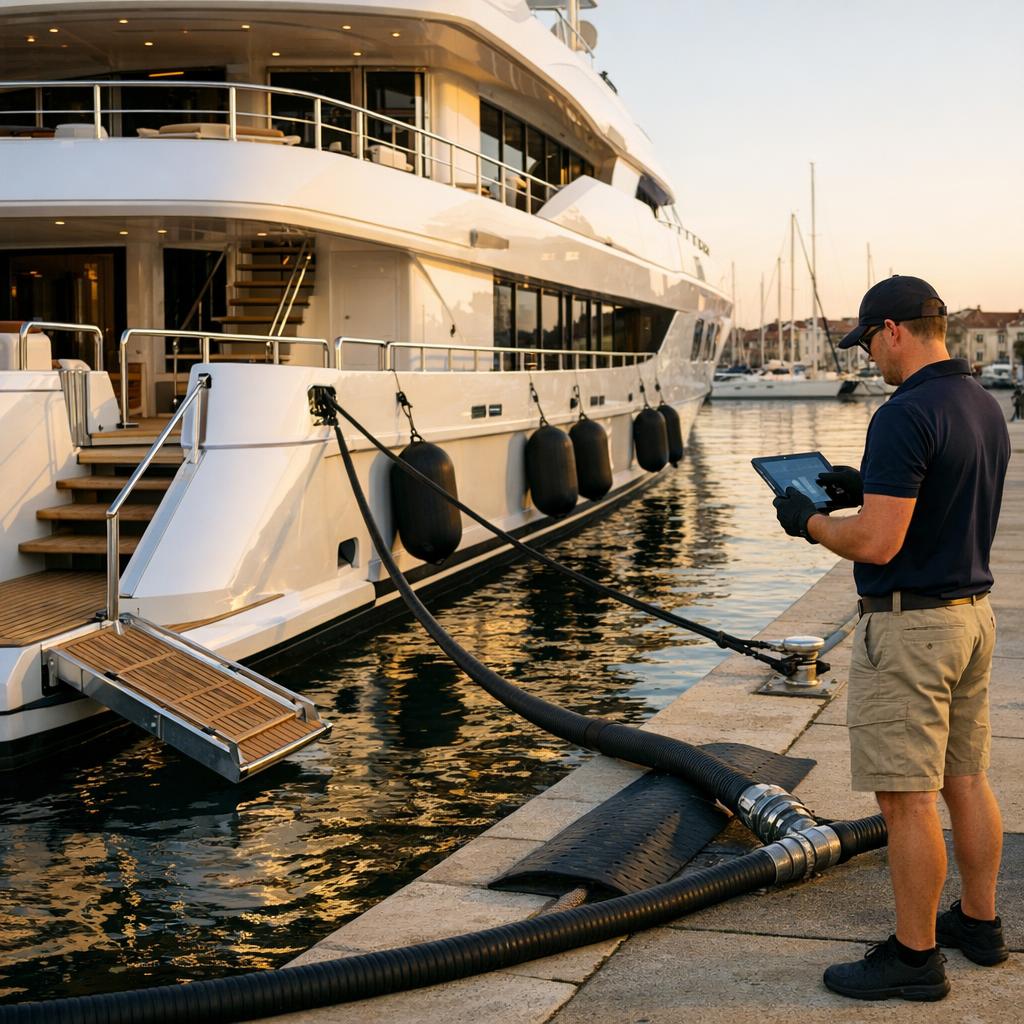
Factors determining consumption per hour
No two superyachts are identical. In practice, these factors determine hourly consumption most strongly:
- Length and displacement - Larger and heavier yachts require more power and therefore more litres per hour.
- Hull type - Displacement hulls are efficient at cruising speed, planing hulls consume more at higher speeds.
- Cruising speed - Every extra knot costs disproportionately more fuel. Eco-speed significantly reduces litres per hour.
- Sea and weather conditions - Wave action, wind and current increase drag and consumption.
- Loading - Number of guests, provisions, toys and full tanks affect total weight.
- Hotel amenities - Air-conditioning, kitchen appliances, lighting and entertainment in suites increase generator consumption, including at anchor.
- Technology and fuel - Hybrid systems, modern propulsion and HVO can reduce consumption.
Indicative fuel consumption per hour per length class
The bandwidths below provide a realistic starting point for planning. The values for cruising speed are indicative for 10 - 12 knots and exclude hotel facilities, which are shown separately.
| Lenght class | En route 10 - 12 knots (L/hour) | At anchor, hotel facilities (L/hour) |
|---|---|---|
| 24 - 30 m | 120 – 250 | 60 – 120 |
| 30 - 40 m | 200 – 400 | 80 – 160 |
| 40 - 50 m | 300 – 600 | 100 – 200 |
| 50 - 70 m | 400 – 900 | 150 – 300 |
| 70 - 90 m | 600 – 1.500+ | 200 – 400 |
Innovative, hybrid newbuild yachts can come out exceptionally low at eco-speed, with publications of around 45 - 100 L/hour at 10 - 12 knots for specific models. Consider these values as best-case examples, not market averages. Actual figures are affected by route, loading and conditions. Want to know if fuel is included in your charter? View Is fuel included with a superyacht charter?
Practical maths: how to estimate fuel costs for your route
- Determine the indicative consumption per hour for your length class from the table.
- Estimate hours of sailing per day and hours at anchor.
- Calculate consumption underway: consumption per hour x sailing hours.
- Add consumption of hotel facilities: hotel L/hour x anchor hours.
- Multiply total by local diesel price at destination.
Example: a 38m yacht sails for 5 hours at 300 L/hour and anchors for 7 hours at 120 L/hour. Daily consumption is 5 x 300 + 7 x 120 = 1,500 + 840 = 2,340 litres. Multiply this by the current price per litre on site. Global Yacht Charter provides customised trip planning and calculation per yacht and destination upon request.
How fuel calculation via APA works
In a superyacht charter, variable costs such as fuel, provisions and harbour fees are settled through Advance Provisioning Allowance (APA). You pay an amount into the APA in advance, the captain books all variable expenses into this and shares transparent statements throughout the week. A settlement follows at the end, with a possible top-up or refund. Our communicated charter prices are weekly, excluding VAT and APA. The charter price is seasonal: a fixed price in low season and a fixed price in high season. With the APA, you keep control of the actual fuel consumption and associated costs during your trip. Read more about the cost of a superyacht charter. Are you orientating on the total cost including crew? See what it costs to charter a yacht with staff.
Frequently asked questions
How much fuel does a superyacht consume?
For 24 - 30 m, count on around 120 - 250 L/hour at 10 - 12 knots and 60 - 120 L/hour for hotel facilities at anchor. Larger yachts consume correspondingly more. Exceptionally efficient hybrid yachts may be lower at eco-speed.
How much does it cost to fill up a superyacht?
It depends on tank capacity and local diesel prices. Tank volumes range from tens of thousands to several hundred thousand litres on the largest yachts. During a charter, refuelling is usually not "full" but bunkered as required and settled through the APA. In doubt as to whether fuel is included? Fuel generally falls under the APA and is charged according to consumption.
What does a superyacht cost per day?
Daily prices follow from the seasonal weekly price, excluding VAT and APA. Variable costs such as fuel are settled separately through APA. The time of booking does not change the charter price. See what a yacht costs per day.
What are the fuel costs for a yacht?
Use the formula litres per hour x sailing hours plus hotel facilities per hour x anchorage hours, and multiply by the local diesel price. We are happy to provide an exact estimate per yacht, route and travel pace.
More efficient cruising without compromising on experience
- Choose eco-cruising speed - 1 to 2 knots slower often saves tens of percent consumption.
- Plan smart itineraries - Fewer long crossings and sailing in favourable weather conditions reduce litres per hour.
- Use shore power - Using shore power in port reduces generator hours.
- Clustering activities - More time at anchor at highlights limits unnecessary trips.
- Hybrid and HVO - Consider yachts with hybrid systems or HVO compatibility where available.
- Bespoke provisioning - With your private chef, you avoid unnecessary extra trips for provisioning.
Would you like exact figures for a specific yacht and sailing area, or a sample budget including APA and fuel consumption per hour? Contact Global Yacht Charter for a tailor-made proposal. If you are travelling to your departure port by private jet, our sister company Global Aviation can gladly arrange this for you.