
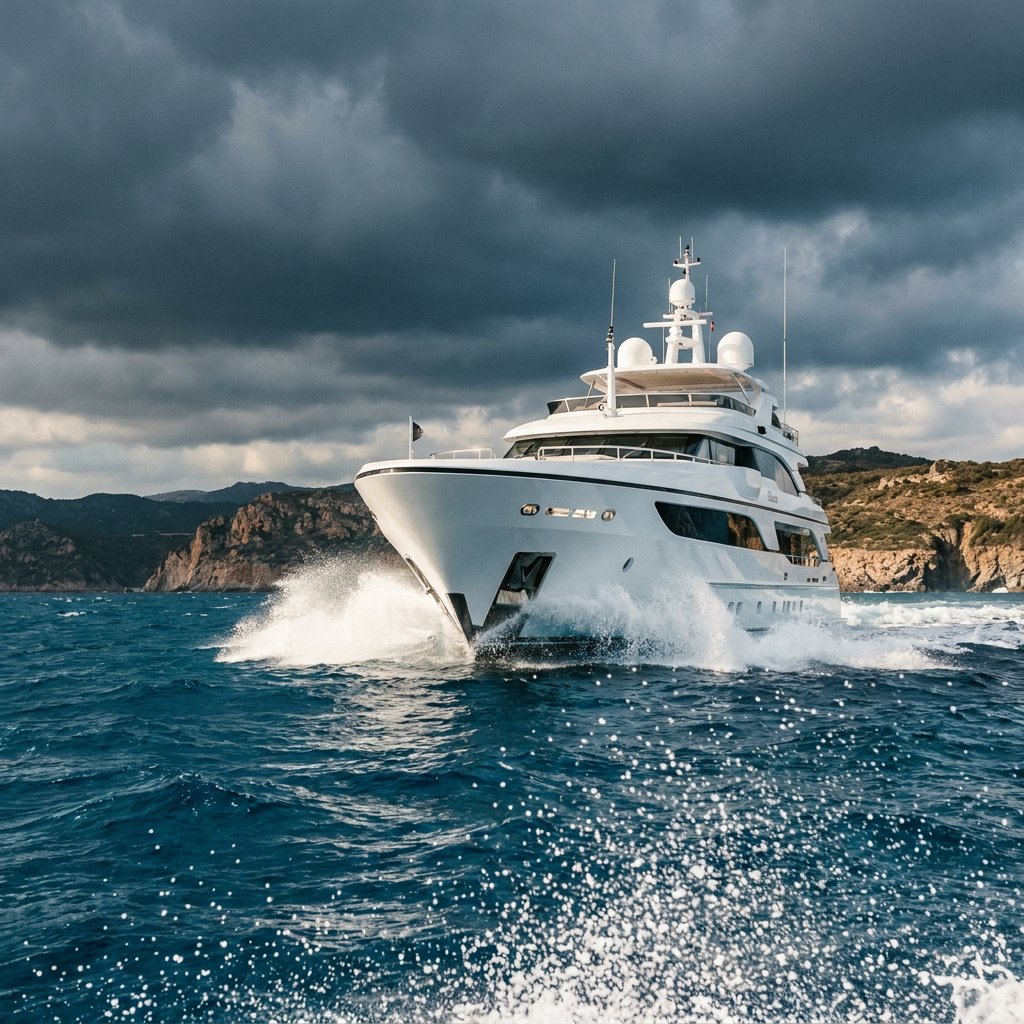
At Global Yacht Charter, the charter experience is all about comfort, privacy and a carefully planned voyage. That is precisely why realistic information is important: even a large yacht is not a vessel that can seek out rough seas indefinitely. Professional route planning and an experienced crew are essential to minimise risk and ensure the journey is as pleasant as possible.
The short answer
A modern superyacht is fundamentally designed for serious sailing at sea and can cope with far more than smaller pleasure craft. However, that does not mean that every superyacht is safe or comfortable in all types of bad weather. High waves, strong winds, the direction of the swell, visibility, distance to a safe harbour and the technical condition of the yacht all make a difference.
In other words: a superyacht can generally cope with rough seas, but the answer isn’t simply a case of yes or no. The real question is how severe the conditions are and whether the crew chooses to seek them out, avoid them or wait them out.
What does it depend on?
Size and hull shape
Larger yachts often ride more smoothly than smaller boats. Greater length and mass can help to make movements less abrupt. However, this does not automatically mean that a larger yacht is always comfortable. Even a long superyacht can struggle in steep swells or rough seas.
Construction and technical condition
A well-maintained superyacht with a professional crew is quite different from a vessel that only looks impressive on paper. Technical reliability, functioning systems and good maintenance are crucial as soon as the weather takes a turn for the worse.
Route and cruising area
The open ocean, coastal waters and sheltered sailing areas place different demands on a yacht and on the planning involved. The same superyacht may sail comfortably in one area, whilst in another it may be subjected to much harsher conditions due to wave patterns, wind and currents.
The captain and crew
This is often the most underestimated factor. An experienced skipper does not try to prove that the yacht can handle rough seas, but rather to manage them. This is done by monitoring weather systems, adjusting routes, changing speed, seeking shelter or postponing departure. Safe sailing is therefore not just a question of what the yacht is capable of, but of what the crew considers sensible. Read more about the division of duties and crew complement on a 40-metre yacht.
Surviving rough seas is quite different from sailing in comfort
Many people use the terms ‘survive’ and ‘cope’ as if they were the same thing. They are not. A superyacht may be technically capable of withstanding rough seas, whilst the experience on board is still uncomfortable or exhausting. Rolling, pitching, noise, movement in the suites and limited time on deck can drastically alter the experience.
For a luxury charter, that distinction is important. Guests are not usually looking for a yacht that can brave extreme seas, but for a voyage that feels safe, relaxed and sophisticated. In practice, therefore, the route is usually planned to take advantage of favourable weather conditions and sheltered anchorages or harbours wherever possible.
Can a yacht cross the ocean?
Some yachts are capable of crossing the ocean, but not every charter yacht is designed for the same kind of long open-water crossings. There are superyachts that are used for serious crossings and longer voyages, whilst others excel primarily in regional cruises along coastlines and around islands.
For charter guests, this is particularly relevant when planning a trip. An ambitious route across open water requires a suitable yacht, a realistic timetable and a crew accustomed to that type of crossing. It helps to know how far you can sail each day.
What happens if the weather suddenly takes a turn for the worse?
On professionally crewed superyachts, bad weather is not an isolated incident, but part of ongoing monitoring. The captain keeps an eye on forecasts, sea conditions and alternative routes. If the weather deteriorates more quickly than expected, the crew can alter course, adjust speed, limit activities and seek out a sheltered location or harbour.
For guests, this usually means that safety on a superyacht takes precedence over the original plan. This may affect the daily schedule or route, but it is precisely this flexibility that is part and parcel of responsible sailing at sea.
What you should bear in mind as a charter guest
If you’re wondering whether a superyacht can survive rough seas, there’s often a practical question behind it: will my trip be organised safely and comfortably? The key points to consider are:
- The sailing area – the open sea demands more in terms of planning and yacht maintenance than sheltered coastal routes
- The season – weather patterns and wave conditions vary greatly by region and time of year; see also seasons and weather conditions in the Mediterranean and the Caribbean
- The route – a scenic route isn’t always the wisest choice at that particular moment
- The crew – a professional crew makes all the difference when it comes to preparation and decision-making
- Your expectations – comfort and tranquillity sometimes require you to adjust your pace or destination
Anyone planning a charter would be well advised to discuss this topic at an early stage. Not out of concern, but to ensure the trip is properly tailored to your wishes, the season and the chosen cruising area. This checklist for planning a charter will also help with this.
FAQ
Is a larger superyacht always safer in rough seas?
Not necessarily. A larger yacht may offer advantages in terms of stability and comfort, but safety also depends on the design, maintenance, route, load and the decisions made by the crew.
Is rough seas common during a luxury yacht charter?
Not as a matter of course. Professional charters are normally planned with due regard to weather conditions, so that the voyage is as safe and comfortable as possible. If the weather deteriorates, the route can be adjusted.
Can guests suffer from seasickness, even on a superyacht?
Yes. Even on a large yacht, swell and waves can be noticeable. The impact varies depending on the person, the yacht and the sea conditions. That is why choosing a sheltered route often helps just as much as opting for a larger yacht.
Does an ocean-going appearance mean that every yacht is suitable for rough open seas?
No. Appearance, size and luxury do not tell the whole story about a yacht’s actual operational capabilities. Its suitability depends on the specific yacht, the sailing area and the planned route.
Are you planning a charter in a cruising area where the open sea, longer crossings or changeable weather conditions are a factor? If so, expert advice will help you choose the right charter yacht and a route that suits your comfort, safety and travel preferences.
